
होमKabaddiCommonwealth Kabaddi Championship 2026: 13 Nations in Ahmedabad, India Favoured in Both Draws — But the Broadcast Question Remains Unanswered
Kabaddi
Commonwealth Kabaddi Championship 2026: 13 Nations in Ahmedabad, India Favoured in Both Draws — But the Broadcast Question Remains Unanswered
कॉमनवेल्थ कबड्डी चैंपियनशिप 2026 का आयोजन 23 से 31 अक्टूबर तक अहमदाबाद के वीर सावरकर स्पोर्ट्स कॉम्प्लेक्स में होगा। यह टूर्नामेंट का पहला संस्करण है और इसमें 13 देश भाग ले रहे हैं; पाकिस्तान के नाम वापस लेने के बाद यह संख्या 13 रह गई है, और वापसी का कारण आधिकारिक रूप से स्पष्ट नहीं है। पुरुष और महिला, दोनों वर्गों की अलग प्रतियोगिताएं होंगी। भारत दोनों वर्गों में खिताब का प्रबल दावेदार है, लेकिन महिला वर्ग में ईरान की चुनौती पुरुष वर्ग से अधिक नज़दीक मानी जाती है। मुख्य उद्देश्य 2030 कॉमनवेल्थ गेम्स (अहमदाबाद) के खेल कार्यक्रम में कबड्डी को शामिल कराने का मामला मजबूत करना है। अभी तक किसी आधिकारिक प्रसारक, चैनल या ओटीटी प्लेटफॉर्म की घोषणा नहीं हुई है, इसलिए 'भारत में मुफ्त में कहां देखें' का सटीक उत्तर उपलब्ध नहीं है; दर्शकों को आधिकारिक घोषणा का इंतज़ार करना चाहिए और अनधिकृत लिंक से बचना चाहिए। 13 टीमों और 9 दिनों के आधार पर प्रारूप लगभग निश्चित रूप से दो पूल और उसके बाद नॉकआउट का होगा, क्योंकि पूरा राउंड-रोबिन इस अवधि में संभव नहीं। आयोजन का स्वीकृति प्राधिकरण, नियमावली, एंटी-डोपिंग ढांचा और स्क्वाड सूची सार्वजनिक रूप से घोषित नहीं हैं — ये पारदर्शिता और शासन से जुड़े बड़े सवाल हैं।
Ahmedabad: The Commonwealth Kabaddi Championship 2026 will be held from 23 to 31 October at the Veer Savarkar Sports Complex in Ahmedabad, Gujarat. The tournament is in its inaugural edition and features 13 participating nations. That number stands at 13 after Pakistan withdrew its entry, and no official reason for that withdrawal has been placed on record. Hosts India are considered the strongest favourites in both the men's and women's draws — although that claim rests on no published squad list, no statistics and no ranking basis of any kind.
The nine-day event will run separate men's and women's competitions inside the same window. The organisers have stated explicitly that the purpose is to popularise kabaddi across Commonwealth countries and to strengthen the case for its inclusion in the sports programme of the 2030 Commonwealth Games. Since the 2030 Games are proposed for Ahmedabad itself, this Championship is not only a competition but a substantial dress rehearsal for the host city's delivery apparatus.
That is why the tournament should be read institutionally and politically rather than purely as sport. Thirteen nations out of the Commonwealth's 56 members is an honest, unvarnished measure of kabaddi's global footprint. Presenting it as a 'global kabaddi revolution' would be packaging rather than fact.
Why the rules matter
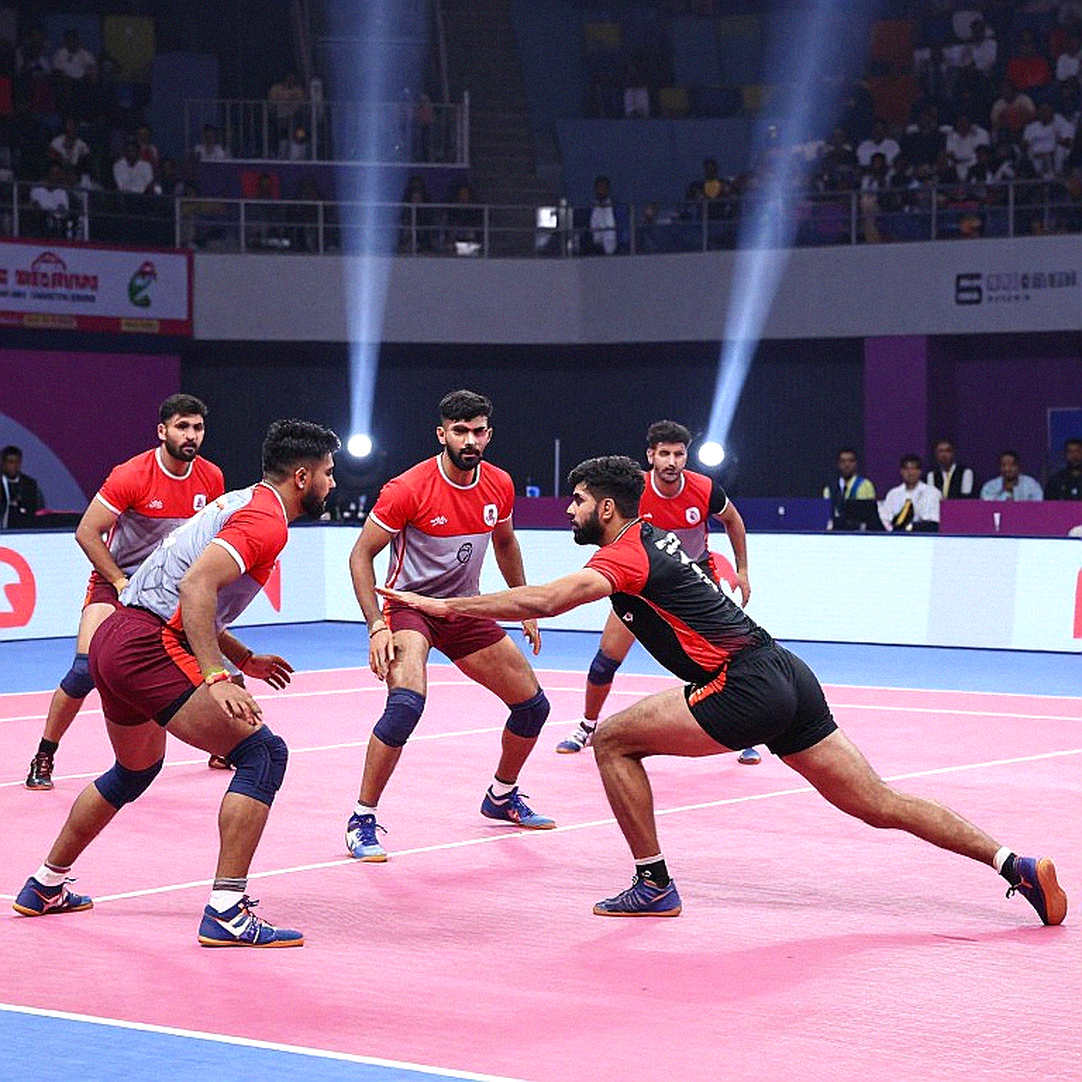
For readers unfamiliar with the sport, the basics are these. The raider is the attacking player who enters the opposition half to score. A raid is a 30-second attempt in which the raider must chant 'kabaddi, kabaddi' continuously — this is the cant. That single rule turns kabaddi from pure athletics into a breath-control sport; if the chant breaks, the raid is void and the raider is out. The defending side collectively stops the raider, which is a tackle, and earns a point. The bonus line sits deep in the opposition half; when the defence has six or more players on court and the raider crosses it, he earns a point — a rule that punishes passive, deep-defending teams.
The most decisive mechanism is the All Out: when all seven of a side are dismissed, the opposition receives two additional points and the entire team revives. This 'team-wipe reset' is what makes kabaddi a sport of rapid, violent swings. Alongside it sits the Do-or-Die raid — after two consecutive empty raids, the third becomes compulsory-scoring, or the raider himself is out. That is the anti-stalling mechanism.
If the Commonwealth Championship is internationally sanctioned, it will be played in Standard Style — the 13m × 10m rectangular court used in Pro Kabaddi and at the Asian Games. Circle Style is Punjab's rural format and is unlikely to apply here. But it is worth noting that no official communication clarifies which rulebook governs the event: the international federation's standard code, a domestic variant, or a Commonwealth-specific adaptation. This is no small omission. Multi-nation events with mixed officiating standards are historically where disputed calls and walkovers begin.
Do the format maths
Thirteen teams over nine days raises a question on its own. A full round robin would require roughly 78 matches, which is impossible in nine days. It is therefore highly likely that the format is two pools followed by semi-finals and a final. The direct consequence is multiple matches per day, which raises the stakes on rotation and injury management far above what a breezy 'India are favourites' framing implies.
India: an asymmetry between the draws
India being favourites in the men's draw is logical. The host squad's bench will be drawn from Pro Kabaddi-level professionals, and across a 13-nation field India's eighth-to-fourteenth best players would likely start for most participating nations. That is a structural advantage, not individual brilliance.
The women's draw is a different picture, and this is where reporting has been most negligent. Collapsing 'dominance in both categories' into a single sentence does not erase a real asymmetry. The women's field is thinner overall, but the top-end challenger, Iran, is considerably closer to India than in the men's game. For over a decade Iran's women have been the most consistent structural threat in Asian kabaddi. The women's final is therefore more likely to be competitive than the men's final.
The second key point is that women's kabaddi has no professional league backstop — the league remains men-only. The women's competition at this event therefore matters far more to the sport's development than the men's; it is their principal route to visibility. Treating the two as interchangeable conceals this.
Pakistan's withdrawal: the least-reported fact
Pakistan's withdrawal is the single most under-reported element of this tournament, and no reason has been given anywhere — a news report without that reason is incomplete. Kabaddi is one of the few sports where an India-Pakistan fixture carries cricket-level emotional intensity. Removing that fixture diminishes the event's competitive value and its emotional pull. It also mechanically inflates India's favourites status, because the one opponent with a strong Circle Style tradition and deep kabaddi culture has left the field.
Technically, in a 13-team field India's players' tackle and raid totals will look artificially inflated. Extrapolating such numbers, built against low-tier opposition, to Pro Kabaddi or Asian Games contexts is a well-known error. The real analytical value of this event lies not in results but in squad selection — who was given a chance, who was rested, and what the pipeline for the next cycle looks like.
Broadcast: the report's biggest hole
The headline promises, first and foremost, to tell readers where and how to watch the tournament free in India. Yet no official information names a channel, an OTT platform or a broadcast partner. The section headed 'List of all teams' is also empty — a heading with no list beneath it.
This is not a minor editorial slip. A pre-event utility report that fails to deliver its own core utility is a clear sign of template-driven or aggregated content production, where the headline is written against search intent before the facts are secured. Two conclusions follow. First, broadcast arrangements genuinely had not been finalised at the time of writing. Second, if they had been, the information never reached the publisher. Either way, the message is the same: this event's broadcast distribution is not yet a settled commercial product.
The word 'free' in the headline carries its own signal. It points towards a free-to-air or free-streaming model rather than a premium subscription channel. That is also rational — an inaugural event has no proven audience demand, so building a paid tier is hard. Free distribution buys reach and strengthens the 2030 Commonwealth Games case.
Governance and institutional questions
The biggest question is who is the sanctioning authority. Is it the international federation, a Commonwealth kabaddi body, or the domestic association? That information is on record nowhere. This is not a formality. Multi-nation events without a clearly declared sanctioning body have historically produced eligibility disputes and unratified results. Likewise, the anti-doping framework, referee review mechanism, appeals process and athlete registration are none of them publicly stated.
A structural conflict of interest is also inherent: India is simultaneously host and the dominant team, while its strongest traditional rival is absent. This is a normal feature of host-nation dominance in emerging sports, but the question will be asked at any disputed moment.
The 'inaugural edition' claim should also be read cautiously. Events under 'Commonwealth' branding have been staged in kabaddi before. It is safer to treat this as the first edition under the current organiser until independently verified.
What viewers should watch
For those who intend to watch, the practical advice is to wait for a broadcast announcement and not to trust unauthorised links. On the sporting side, three things are worth following: India's rotation — who plays continuously and who is rested; how India's defensive chain holds against Iran in the women's draw; and the bench capacity of the smaller nations, which may prove the decisive differentiator of the tournament.
The conclusion is clear. The Commonwealth Kabaddi Championship 2026 is a real event, but it is not yet a fully defined product. Its sporting significance is moderate; its political significance is greater; and its media significance is still uncertain. Treating it as an equal of the Asian Games would be a mistake. In any case, until the 2030 Commonwealth Games sports programme is decided, the political weight of the Championship's second edition will far exceed the first — and the real contest will take place in meeting rooms, not on the mat.
संबंधित खिलाड़ी
अनुशंसित
India vs England, Match 4, Commonwealth Kabaddi Championship 2026: In Ahmedabad, the Team Sheet Will Tell the Story the Scoreboard Cannot2026-10-23
Commonwealth Kabaddi Championship 2026: 13 Nations in Ahmedabad, India Favoured in Both Draws — But the Broadcast Question Remains Unanswered2026-11-03
Commonwealth Kabaddi Championship 2026, Match 4 — India vs England: Tonight the Scoreboard Will Tell Us the Least2026-10-30
Data unavailable: no kabaddi report can be written from this input2026-10-31
Commonwealth Kabaddi Championship 2026: 23–31 October, 13 Nations, and the Broadcast Question Nobody Has Answered2026-10-23
अनुशंसित
Rotation Is the Real Story: India vs England at the Commonwealth Kabaddi Championship 20262026-10-24
Who Holds Kabaddi's Real Scorecard: From Jakarta's 18-27 to Today2026-10-25
Data unavailable: no kabaddi report can be written from this input2026-10-31
Do-or-Die Conversion: Kabaddi's Real Currency Number, and the Super 10 Illusion2026-10-31
Commonwealth Kabaddi Championship 2026: England's 68-18 Tells Us More About India Than Three Wins Do2026-10-27
अनुशंसित
Commonwealth Kabaddi Championship: India Open Against Malaysia (Women) and England (Men) as Ahmedabad Hosts Historic First Edition2026-11-03
Commonwealth Kabaddi Championship 2026: England's 68-18 Tells Us More About India Than Three Wins Do2026-10-27
Commonwealth Kabaddi Championship: The 39-23 Gap Inside 62 Matches, and the Women's Draw Test That 2030's File Actually Needs2026-10-23
Surjeet Singh Captain, Naveen Kumar Deputy: The Commonwealth Kabaddi Championship Announcement From Ahmedabad, And What It Leaves Out2026-10-23
Thirteen Names and One Empty Chair in Ahmedabad: The Kabaddi Ledger Behind Pakistan's Withdrawal2026-10-23