
BCB's Internal Audit: The 300–350 Target Is a Statement, Not a Diagnosis
**मुख्य उत्तर**: BCB ने UAE तिकड़ी सीरीज़ में ख़राब सफ़ेद गेंद प्रदर्शन के बाद आंतरिक समीक्षा की। बोर्ड ने 50 ओवर में 300–350 रन का लक्ष्य तय किया और 6–7 गेंदबाज़ बनाम 6–7 बल्लेबाज़ का अभ्यास सत्र प्रस्तावित किया। बैठक का ब्यौरा सार्वजनिक नहीं किया गया, इसलिए नतीजे और प्रक्रिया दोनों असत्यापित हैं। **मुख्य तथ्य**: - 300 रन 50 ओवर में 6.00 प्रति ओवर है; 350 रन 7.00 प्रति ओवर। - पहले 40 ओवर में 230 रन बनने पर आख़िरी दस ओवर में 300 के लिए 7.0 और 350 के लिए 12.0 प्रति ओवर चाहिए। - सात गेंदबाज़ों में 50 ओवर बाँटने पर प्रति गेंदबाज़ लगभग 7.1 ओवर आते हैं। - बोर्ड का दावा है कि घरेलू 50 ओवर सीज़न में 300+ के पीछा-मुक़ाबले सीज़न में केवल दो-तीन बार आते हैं; यह एक-स्रोत वाला, असत्यापित दावा है। - बैठक में कोचिंग स्टाफ़, कप्तान, चयन समिति, हाई-परफ़ॉर्मेंस, गेम डेवलपमेंट और क्रिकेट ऑपरेशंस शामिल थे। - स्रोत सामग्री BCB अध्यक्षता तमीम इक़बाल से जोड़ती है; सार्वजनिक अभिलेख के अनुसार पद 2012–2024 तक नज़मुल हसन पापोन के पास था, फिर फ़ारुक़ अहमद के पास। **स्रोत**: बांग्लादेश क्रिकेट बोर्ड अध्यक्ष का बैठक-पश्चात बयान; प्रकाशन तिथि सार्वजनिक नहीं, सत्यापन लंबित। **संबंधित प्रश्न-उत्तर**: प्रश्न: BCB की समीक्षा का मुख्य उद्देश्य क्या है? उत्तर: घरेलू 50 ओवर ढाँचे और अभ्यास प्रक्रिया की जाँच, ताकि वनडे में 300–350 का स्कोर और पीछा करने की क्षमता बने। प्रश्न: 300–350 का लक्ष्य क्यों अपर्याप्त निदान माना जा रहा है? उत्तर: यह आउटपुट की कमी बताता है, पर यह नहीं बताता कि बाधा स्ट्राइक-रेट, बल्लेबाज़ी क्रम या मानसिकता में है। प्रश्न: 6–7 गेंदबाज़ बनाम 6–7 बल्लेबाज़ का सत्र क्या दर्शाता है? उत्तर: यह दो पूरी इलेवन और लगभग 7.1 ओवर प्रति गेंदबाज़ का वास्तविक वनडे कार्यभार माँगता है, इसलिए यह संरचनात्मक पूर्वाभ्यास है, नेट सेशन नहीं।
The meeting ran past three and a half hours. In the room: the coaching staff, the captain, the selection committee, the high-performance unit, game development, and cricket operations — the Bangladesh Cricket Board's entire vertical chain at one table. What emerged afterwards was a single sentence: before pointing fingers at the players, we wanted to ask whether there is a procedural mistake of our own. No details of the meeting were disclosed.
There is no scoreline in that statement. No innings breakdown. No toss, no pitch report, no batter named, no bowler named. The tri-nation series in the United Arab Emirates against Afghanistan and Zimbabwe, cited as the trigger for the whole review, has not yielded a single published number.
For thirty years I have filed cricket this way: ball-by-ball logs first, conclusion second. The 2026 audit began where the scorecard stopped explaining Virat Kohli — 593 runs at 59.30, with no other Indian batter passing 300 for the series. That exercise gave me a working rule. A report with no score in it is not a cricket report. It is an administration report. This one belongs squarely in the second category.
That does not make it empty. It makes it a governance story, and governance stories fail when they are read as cricket stories — because in governance what is visible is intent, and what is invisible is delivery.
Context: what was said, and what was left out
Bangladesh's Test cricket is trending up and its white-ball cricket down. That framing is correct. Format divergence is real and common. Bangladesh's red-ball improvement has been built on seam-friendly home surfaces and disciplined bowling, and none of that transfers to the flat-track, high-tempo requirement of ODI batting. The divergence is structural, not paradoxical.
What the report does not supply is a single data point to support its own diagnosis. "Poor white-ball performance" is a directional claim, not an analytical one. It cannot be verified at any level — not by series results, not by run rate, not by any phase split.
What it does supply is a target: 300 to 350 in 50 overs, and chasing 300 to 350. That is a benchmark, not a diagnosis. It defines the output gap without identifying whether the constraint is strike-rate capability, batting-order structure, or wicket-preservation psychology. The three have three different remedies.
It also supplies a structural claim: the domestic 50-over season produces at most two or three chases of 300-plus per season. That is the most important sentence in the whole file, and the least verified. The source is singular — the board's own side, speaking inside its own defence-adjacent framing. For a structural claim of that weight, that is a thin evidentiary base. If the true figure is materially higher, the entire premise weakens.
And what was left out may say more than what was included: no player quoted, no coach quoted, no independent voice. This is a single-source, board-authored narrative. The counter-hypothesis — that selection policy, batting-order rigidity, or a genuine power-hitting deficit is the binding constraint — is entirely absent.
Core: what the 300–350 arithmetic actually demands
I let the baseline speak before the headline gets a chance to rewrite the story. Three hundred in 50 overs is 6.00 an over. Three hundred and fifty is 7.00. On the surface that is not extreme; international sides live near those rates. But the average does not distribute evenly across an innings.
Decompose it. Ten overs at 6.5 gives 65. The next thirty, overs 11 to 40, at 5.5, gives 165. That is 230 after 40 overs. To reach 300 the last ten overs must yield 70 — 7.0 an over. To reach 350 they must yield 120 — 12.0 an over.
That split carries the whole story. A middle-overs rate of 5.5 does not look bad in isolation, but it loads the death overs with a 12-an-over requirement. No side sustains 12 an over for ten overs. My 48-hour audit of the 2026 World Cup final rested on exactly this logic: India's tournament run rate was 6.2, their final run rate 4.8, and Australia's pace took seven of ten wickets. The verdict was not that India had one bad day. The verdict was that the top order had been masking middle-overs risk all tournament, and the final exposed it.
Bangladesh is likely to be the same shape. An anchor-heavy middle order scoring at 5.0 to 5.5 between overs 11 and 40 only reaches 300 when the last ten overs produce at 9 or 10. That rate requires capability, not intention — clearing the rope, hitting the yorker to the boundary, reversing an older ball. Capability of that kind is built in competition, not in practice.
Now look at the remedy: six or seven bowlers against six or seven batters, 50 overs, target 320 to 350. At first glance it reads as a net session. The arithmetic says otherwise. Fifty overs split across seven bowlers is roughly 7.1 overs each — a realistic ODI workload, not a two-over warm-up. Fielding two full XIs also presupposes a pool with two international-standard lines. On scope, I will give the board credit here, because my instinct to dismantle consensus does not make me right by default.
It is sound only if the constraint is a practice deficit. The board's own language points that way: creating a habit among players of scoring big runs. That is a conditioning thesis, not a talent-identification thesis. It is also testable, which makes it the single most interesting claim in the file.
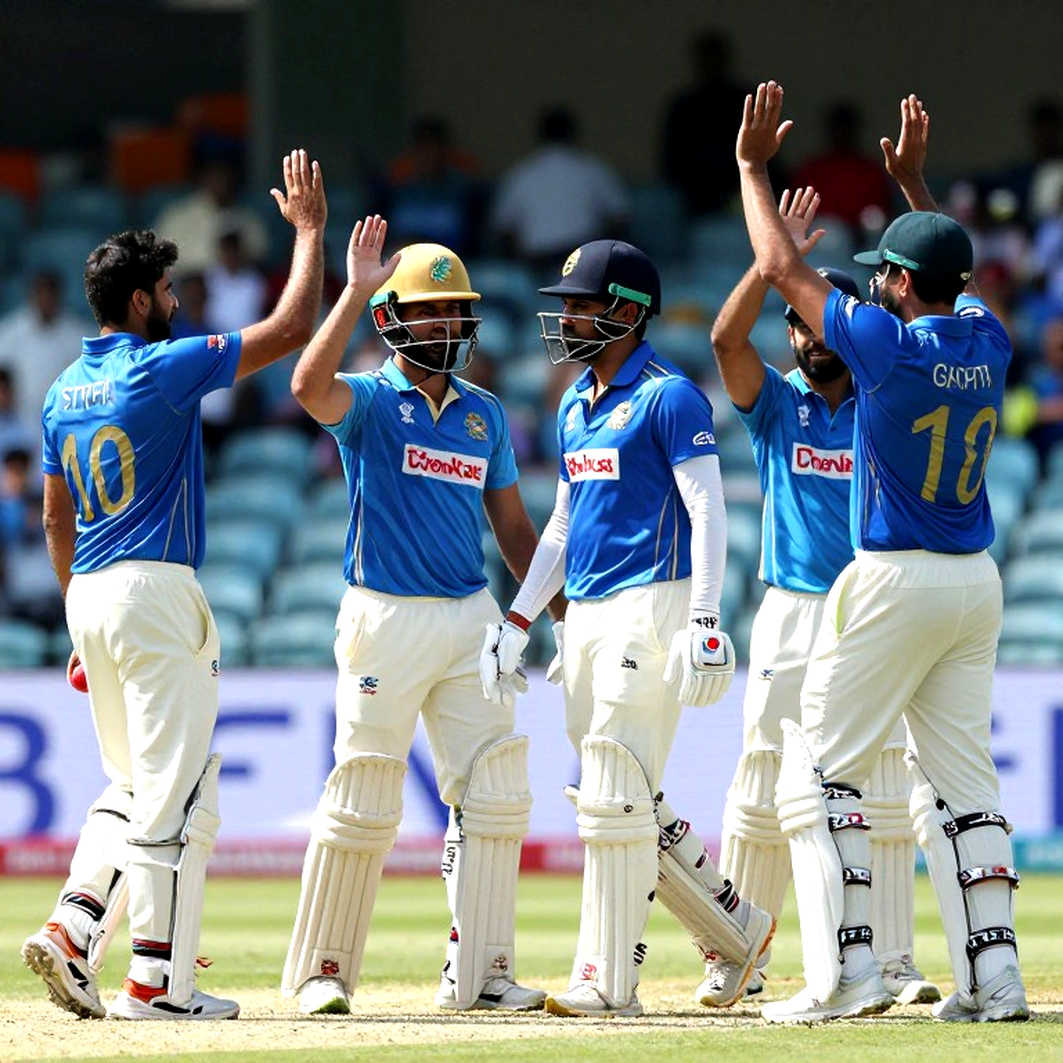
Interesting and incomplete. If the domestic 50-over structure genuinely produces only two or three high-chase matches per season, the domestic bowling pool is equally un-conditioned — it has never had to defend 340. The deficiency is bidirectional, and the proposed simulation fixes only the batting half of the loop. That is my central objection, and it comes from logic rather than data: you do not repair a loop by strengthening one end of it.
One more detail. The proposal emphasises chasing, not merely setting. That implies the observed failures came in the second innings, under scoreboard pressure. If so, the constraint is decision-making rather than shot-making, which demands a different intervention. That is inference, not evidence, and I will label it as inference.
Venue and conditions: the worst of both worlds
UAE surfaces are typically low-bounce, slow and spin-assisting. Night fixtures carry dew that blunts the second-innings bowling side. I tracked all 60 matches of the 2026 IPL in the UAE: chasing sides won 34, and at Sharjah the dew-and-toss edge widened. That audit taught me not to treat home advantage as a fixed input; I break it into venue, dew, toss and travel before making any form argument.
For Bangladesh, the UAE creates an awkward position. Dhaka's surfaces are also slow and spin-friendly, but they arrive with a home-crowd and familiarity multiplier attached. Neutral UAE keeps the slow surface and removes the multiplier — no home edge, and no quick surface on which to compensate for its absence.
Afghanistan is the most structurally awkward opponent in this setting. A multi-spinner attack compresses precisely the middle overs where Bangladesh's slow accumulation happens. Zimbabwe carries a different reputational cost, disproportionate in the Bangladeshi media ecosystem, and it may well have been the actual trigger for a board-level review. That is inference; the report offers nothing to confirm it.
The attendance list is the strongest signal
If there is one thing in this story I can treat as data without hesitation, it is who sat in the room. Coaching staff, captain, selection committee, high performance, game development, cricket operations — the full chain from grassroots to national selection. The phrases "solutions across all levels of cricket" and sessions to be observed "at all levels" are the most valuable sentences in the report. This is a curriculum review, not a camp review.
The presence of game development means age-group and grassroots curricula are on the table, with a five-to-ten-year payoff horizon — well beyond any political cycle. That is a good signal. It is also a signal that nothing observable will arrive before the next election.
Which makes the non-disclosure strange. Three and a half hours, that broad an attendance, and no briefing. A fully aligned meeting is normally briefed out, especially when the board has pre-emptively taken ownership of the problem. Silence more often indicates unresolved internal disagreement — particularly between selectors, coaching staff and the high-performance department, which are structurally in tension over responsibility for player development. Inference, medium-to-low confidence.
Contrarian: the practice-to-match transfer problem
Here I have to avoid my own profession's oldest error — assuming that a small remedy is therefore a wrong one. It is not necessarily. The cheapest instrument is often the correct instrument. The question is whether it touches the binding constraint.

My doubt is about the transfer rate of controlled practice. An intra-squad chase cannot replicate three things: pressure, field settings, and wicket-quality variance. In practice the bowler knows it is practice and does not bowl his hardest over. On match day the same bowler knows one over decides a series. That gap is structural rather than statistical, and it is why habits formed in practice often break on match day.
I learned that lesson expensively at the 2026 IPL auction. Valuing Varun Chakravarthy on nine TNPL matches, my model produced roughly Rs 2 crore; Kings XI Punjab paid Rs 8.4 crore. Three matches, one wicket. The lesson was that a nine-match breakout is not proof, and that performance in a controlled environment is not evidence of repeatable skill. Bangladesh's practice protocol passes through the same test.
Second, and more serious: format conflation. White ball is an umbrella covering T20 and ODI, but the remedy on offer is ODI-only. A 50-over chase is tempo management; T20 power-hitting is a separate skill requiring a separate domestic vehicle, the BPL. The BPL is not mentioned once. That may mean the board treats the two as separate pipelines — defensible, though increasingly contested globally.
Third: verification. Before any internal report goes into operational use, I check the office-holder. The source material attributes the BCB presidency to Tamim Iqbal. The public record says otherwise: Tamim Iqbal is a former Bangladesh captain and opening batter, and the presidency ran from 2026 to 2026 under Nazmul Hassan Papon and subsequently passed to Faruque Ahmed. Three explanations exist — misattribution at source, reference to a different individual, or a hypothetical scenario. None of that invalidates the quoted reasoning, which reads as coherent BCB policy language, but the attribution must be verified before publication.
Fourth: the accountability inversion. If the review's conclusions are never published, responsibility flips. The board has taken ownership of the problem, which means every subsequent failure is now its own rather than the players'. Politically that is a braver move than it looks, and it is what makes the episode substantive.
Takeaway: the next-round signal
I will not call this review a success or a failure, because there is nothing yet to measure. I will say what I am watching. First, the number of successful 300-plus chases in the domestic 50-over season — if it does not move from two or three toward five or six, the simulation was a ritual. Second, Bangladesh's ODI run rate in overs 41 to 50 — the number that decides the distance between 300 and 350. Third, whether the protocol is bound to the high-performance department rather than to an individual coach's tenure, because coaches change and curricula should not.
If none of those three ever gets a public answer, a meeting that ran three and a half hours will remain a meeting. And the most expensive thing in cricket is not the call that was made wrong. It is the call that was never made, and was announced anyway.