
होमAsian CricketIndia's Record Storm in New Zealand: Abhishek's 113 off 38, Teenager Sooryavanshi's Fearless Blitz, 199 Chased in 13.2 Overs
Asian Cricket
India's Record Storm in New Zealand: Abhishek's 113 off 38, Teenager Sooryavanshi's Fearless Blitz, 199 Chased in 13.2 Overs
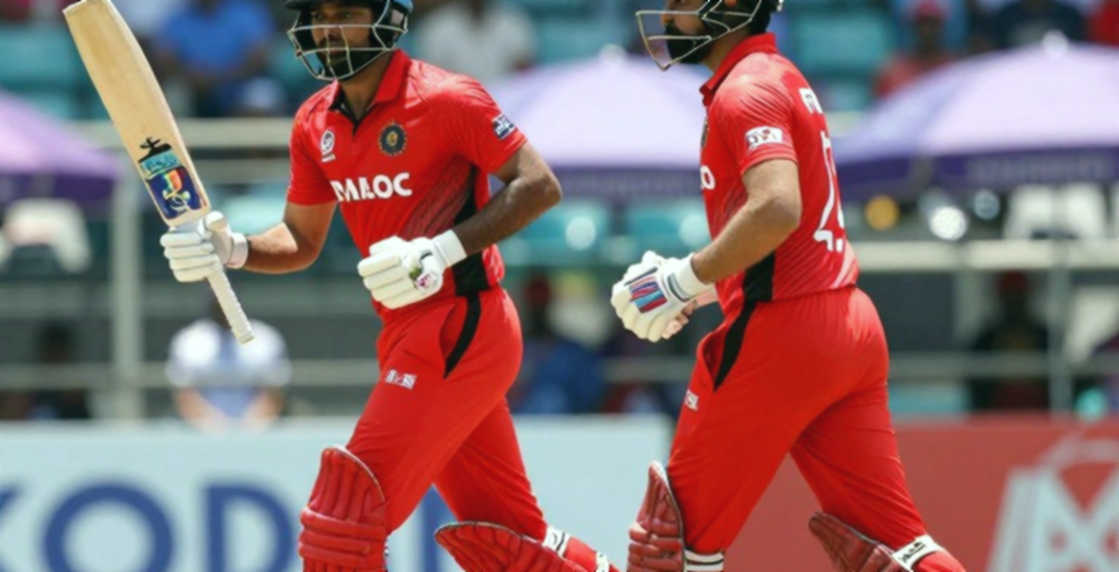
भारत ने न्यूजीलैंड के खिलाफ तीसरे टी20ई में 199 रन का लक्ष्य 13.2 ओवर में छह विकेट खोकर हासिल किया और सीरीज में 3-0 की अजेय बढ़त बनाई। अभिषेक शर्मा ने 38 गेंदों पर 113 रन (11 छक्के, 35 गेंदों पर शतक) बनाए, 15 वर्षीय वैभव सूर्यवंशी ने 19 गेंदों पर 45 रन ठोके और दोनों ने 43 गेंदों पर 133 रन की साझेदारी की। भारत छह ओवर में 118/0 और पांच ओवर में 100 रन तक पहुंचा; अर्शदीप सिंह ने एक कैलेंडर वर्ष में 39 टी20ई विकेट लेकर जोश लिटिल के रिकॉर्ड की बराबरी की। ध्यान दें: अभिषेक के '11 शतक' वाले आंकड़े को टी20ई नहीं, सभी टी20 क्रिकेट के रूप में पढ़ा जाना चाहिए; मैच का वर्ष और स्थान रिपोर्ट में स्पष्ट नहीं है और आंकड़े स्वतंत्र रूप से सत्यापित नहीं हैं।
India chased down a target of 199 against New Zealand in the third T20I of the five-match series, finishing on 199 with six wickets in hand in just 13.2 overs. The match, played on 27 October, gave India an unassailable 3-0 lead and produced a burst of records that reads more like a record register than a scorecard. The chase was completed with 40 balls to spare — roughly seven overs unused — which tells you plainly that the contest was decided inside the first six overs.
Look at the numbers: India were 118 for no loss after six overs, a run rate of 19.67. The team hundred came up inside five overs, and the opening stand put on 133 off 43 balls at 18.13 an over. These figures sit so far beyond normal T20I benchmarks that they must be read as an extreme outlier rather than a new baseline.
Start with Abhishek Sharma, who made 113 off 38 balls — a strike rate of roughly 297. Elite T20I strike rates are generally placed between 160 and 200; 297 is one and a half to two times that. His innings included 11 sixes, and his hundred came off only 35 balls, equalling the fastest T20I century by an Indian.
A technical point matters here. Abhishek's scoring model is six-dominant. Eleven sixes in a 38-ball innings means a large share of his runs came from a small number of events. Such a profile has enormous upside but is also high-variance: on a day when the ball stops, the ground is big, or the opposition removes the boundary option, the same batter can fall cheaply. Treating this innings as his 'new level' rather than his 'ceiling' would be the classic single-innings extrapolation error.
Then there is 15-year-old Vaibhav Sooryavanshi, who made 45 off 19 balls at a strike rate of about 237. A knock like that in senior international cricket at that age is a genuine talent signal, but it is not proof of anything yet. No career T20 data, no domestic benchmark and no split by bowling quality has been offered. The correct analytical stance is therefore 'high potential, unquantified'.
His 133-run stand needs the same caution. In a partnership scoring at 18.13 an over, the junior partner's contribution is substantially a function of the senior partner's strike rotation and boundary rate. It was a superb stand for the team, but it is not independent evidence of Sooryavanshi's individual ability. And most importantly, playing senior international cricket at 15 sits at the most sensitive point of the injury-risk curve; growth-plate and stress-related injuries are most common at this age. This needs saying precisely because the coverage of this match has been uniformly positive and workload management has not been discussed at all.
Now the record list. According to the report, India became the first team to reach 100 inside five overs, and also registered the fastest chase of a 190-plus target against a Full Member side. Abhishek Sharma hit 85 sixes in a calendar year, breaking Rohit Sharma's 2026 mark of 80. Another figure attributed to him is 11 T20 centuries, said to be ahead of Virat Kohli's 10.
This is where the biggest ambiguity lies, and it must be cleared up. Virat Kohli's T20I century count is nowhere near 10, so this figure almost certainly refers to all T20 cricket — franchise plus international — not T20Is. Conflating the two would be a category error. Abhishek's 11 centuries should therefore not be published as a 'T20I record' until officially confirmed. In any case, such a tally is a product of league volume — an artefact of a commercial ecosystem, not a measure of international dominance.
Arshdeep Singh took 39 T20I wickets in a calendar year, equalling Josh Little's record. Note the word: equalled, not broke. Since the headline is framed around 'records broken', this specific item is softer than it appears. Analytically, a calendar-year wicket tally is a schedule-volume metric as much as a skill metric. India play more T20Is than almost any board, so wicket counts scale with opportunity. To judge what the record is worth, you need economy rate and balls per wicket — neither is supplied.
Now the part that record-list journalism tends to skip. India won by six wickets, but they were 118 for no loss after six overs. That means roughly six wickets fell for about 81 runs after the opening stand. Six wickets down from a platform of 118/0 is a process warning, not a process endorsement. Had the target been 220 rather than 199, or the pitch slower, that middle-order stumble could have been the difference.
Another detail absent from the report is the venue and pitch. No ground is named, there is no pitch report, no boundary dimensions. Given 118/0 in six overs and a 199 chase finished with 40 balls spare, a flat deck and/or short boundaries is a strong inference — but it is an inference, not a confirmation. If true, every batting record from this match needs a conditions discount. The toss result is also unreported, so the luck factor cannot be stripped out. There is no mention of rain, Duckworth-Lewis or dew.
Series context also sets the weight of these numbers. This was the third game of a five-match bilateral series, and India led 3-0 after it — the series was already decided. In that situation the opposition attack may have been rotated, frontline bowlers rested, and host priorities shifted. The report tells us almost nothing about New Zealand's team composition beyond Tim Seifert's dismissal. Whether this was a first-choice attack is unknown — and that single variable dominates any conclusion about India's batting.
A basic rule applies too: bilateral T20I results are the least predictive of the three formats. A 3-0 lead in New Zealand is directionally a strong away signal, but it is not evidence of ODI or Test capability. The report nowhere mentions Abhishek's or Sooryavanshi's ODI or Test record. A six-hitting record in T20Is says nothing about red-ball technique, defensive game or middle-overs rotation in 50-over cricket. Any 'next all-format star' framing is unsupported by the data at this stage.
On the commercial side, the market read-across is stronger than the sporting read-across. A 38-ball 113 in a bilateral T20I has modest bearing on India's ODI or Test fortunes, but immediate bearing on T20 franchise valuation, endorsement value and broadcast highlights — the familiar separation of commercial value from sporting value. Interestingly, the 'list of all records broken' format is itself a commercial product; it is built for traffic and shares, not analysis. That is why narrow qualifiers such as 'fastest century against New Zealand' get selected: the narrower the qualifier, the higher the record count.
One hidden dimension is workload. Eighty-five sixes in a calendar year implies a player operating continuously across international and franchise calendars. That is a signal — not a purely positive one, but a marker of fatigue and injury exposure. The same innings that lifts market value also builds physical load. That is the real challenge for team management.
With Arshdeep, remember where his value is concentrated: the new-ball powerplay and the death overs. No death overs were bowled in this match because the chase ended in 13.2 overs, so the game produced no fresh evidence on his death-bowling capability. A calendar-year wicket record often arrives just before auction and selection cycles, so a valuation bump is to be expected — but it should be read as a market reaction, not a performance verdict.
At a system level, one point emerges clearly: India's T20I batting pipeline is producing international-ready hitters at an unusually young age. Two of the three headline performers here are early-career batters. That is consistent with a depth advantage, though one match cannot establish it. New Zealand's position, by contrast, cannot be assessed from this report at all, because almost nothing about their innings is recorded.
On governance, ratification of T20I records falls to the ICC, while player workload and the pathway for a 15-year-old fall to the BCCI. The compliance risk here is low-to-medium, but two things deserve flagging already. First, a date inconsistency: the report references '2026' in one place while never stating the match year, giving only '27 October'. That year must be resolved before any record is cited externally. Second, the T20 versus T20I conflation — a category error that needs correcting before official confirmation.
Finally, a journalistic point. The numbers from this match are real and impressive, but they are low-information. A game that ends in 13.2 overs means the middle-overs containment phase and the death-overs pressure phase — the two most decisive passages of T20 cricket — were never contested. So nothing can be concluded about India's death-over execution or about how set batters accelerate under pressure. What can be concluded is this: the innings was a bright ceiling, not a foundation. Mistaking it for a foundation is the most common error in cricket analysis, and the conversation since this match is heading exactly that way.
The series now stands at 3-0 with two games left. Expect experimentation from both sides, which will widen performance variance in both directions. If the same run rate appears in the remaining games, that will confirm this was not a one-pitch, one-day event. Until then, read these numbers with enthusiasm, not with conclusions.
संबंधित खिलाड़ी
अनुशंसित
Shadman's 99 and Hridoy's Stretcher: What the Mirpur Scorecard Left Out2026-10-29
The Empty File Behind the Full Headline: How Unsourced Cricket Claims Travel2026-10-26
The Rawalpindi Ledger: Minhas's 6/40, Nawaz's 79 and the Unfinished Farhan ODI Question2026-10-23
IND vs NZ 2nd T20I: Before Shreyas Iyer's Captaincy Record, Read Hagley Oval's First Chase2026-10-25
Glenn Phillips's 'Four? Which Ones?' — Dropped Catches Are Not an Official Statistic, and That Is the Whole Story2026-10-24
अनुशंसित
Dhoni's 'Old Vintage Vehicle' and the December Deadline: IPL 2027's Real Question Is the Calendar, Not the Cricket2026-10-30
Nineteen Balls, One Wicket, and a Test Team's Fifth Bowler: Auditing Mominul Haque's 'Extra Responsibility'2026-10-23
Ishan Kishan's Injury and Vaibhav Sooryavanshi's Call-Up: The Selection Sheet Is the Document the Headline Buried2026-10-24
Not a Coin but a Token: Reading the Real Ledger of Bangladesh's D-Three Auction2026-10-26
Kuhnemann's Name Never Came Up: The Blank Page in Australia's Spin-Selection Debate2026-10-25
अनुशंसित